Protect Your Child's Future
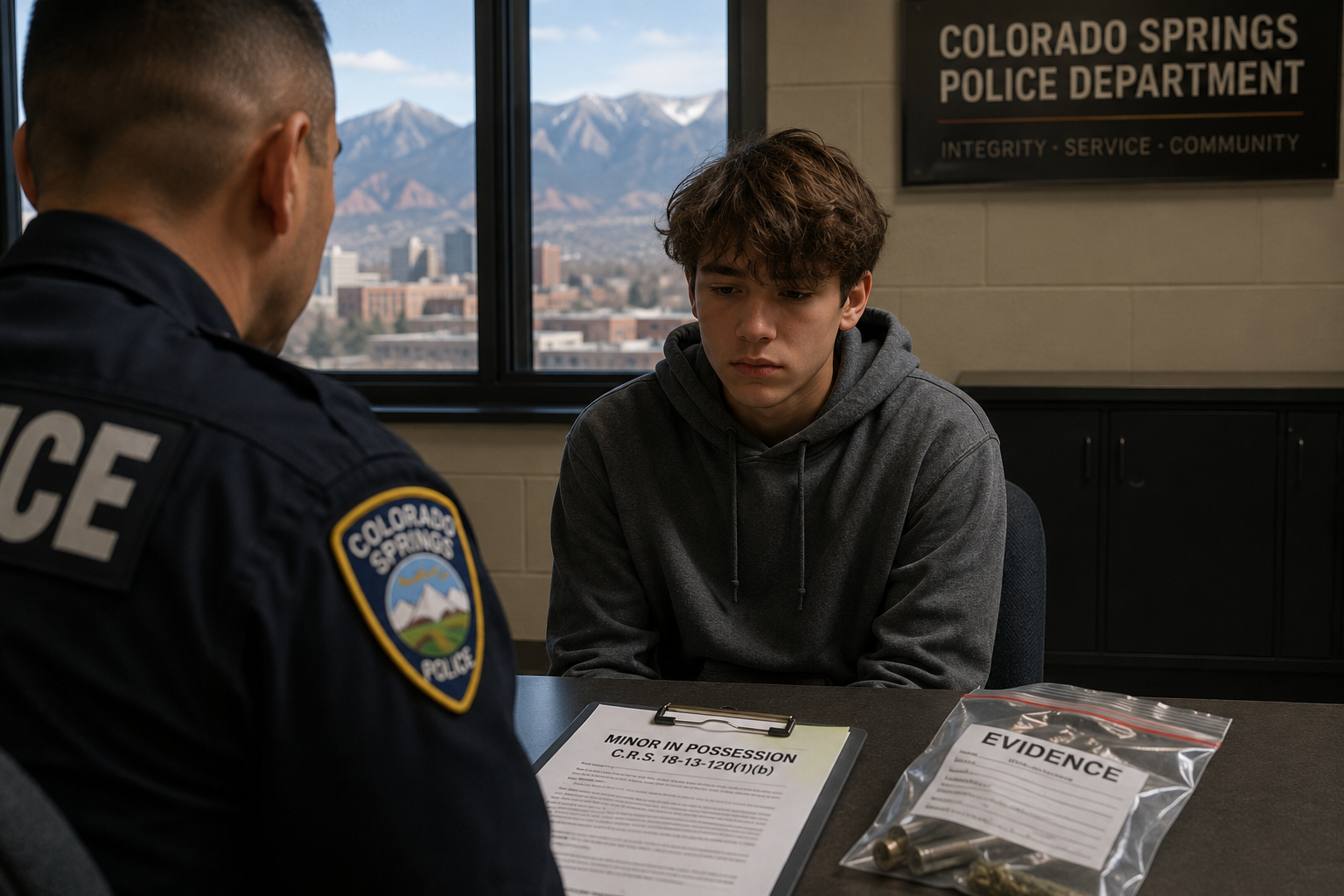
If your child has been cited for minor in possession in Colorado Springs, you probably have two urgent questions: how serious is this, and what should we do right now? Here is the honest answer. Under CRS 18-13-122, minor in possession (MIP) is a strict liability offense for anyone under 21 who possesses or consumes alcohol, possesses or consumes two ounces or less of marijuana, or knowingly possesses marijuana paraphernalia.
Strict liability means prosecutors do not have to prove your child intended to break the law. Holding a friend's drink at a party can be enough for a citation. But an MIP is also one of the most defensible and most fixable charges in Colorado law, with built-in paths to dismissal and record sealing that many families never learn about.
Colorado Springs Criminal Defense, LLC has defended young people in El Paso County courtrooms for two decades. The consultation is free, and the earlier you call, the more options your child has.
Call (719) 578-3344 for a Free, No-Obligation Case Evaluation
Table of Contents
- What Counts as Minor in Possession in Colorado
- MIP Penalties Under Current Colorado Law
- Does an MIP Take Away a Driver's License?
- Why Colorado Springs Families Choose Aaron P. Gaddis
- Defenses to an MIP Charge
- Sealing an MIP Record
- How Our MIP Defense Process Works
- Areas We Serve
- Frequently Asked Questions
- Sources
What Counts as Minor in Possession in Colorado
Colorado's MIP statute, CRS 18-13-122, actually covers three separate offenses. A person under 21 commits a violation by possessing or consuming ethyl alcohol anywhere in the state, by possessing two ounces or less of marijuana or consuming marijuana, or by possessing marijuana paraphernalia while knowing (or having reason to know) it could be used illegally.
"Possession" is broader than most parents expect. Under the statute's definitions, it includes alcohol or marijuana that is merely within a young person's immediate presence and control, not just in their hand or pocket. Police can also build a case on appearance alone: the statute makes signs of intoxication or impairment in someone under 21 prima facie evidence of a violation.
Every violation of the statute, whether a first or a fifth, is classified as an unclassified petty offense, not a misdemeanor. That classification matters. It caps the penalties well below what many websites still claim, and it opens the door to Colorado's most generous record-sealing rules.
Two important boundaries: possession of more than two ounces of marijuana is charged under Colorado's drug statutes rather than the MIP law, and an MIP involving a vehicle can quickly become an underage drinking and driving (UDD) or DUI case, which carries far heavier consequences. If either applies to your child's situation, call us immediately.
MIP Penalties Under Current Colorado Law
Colorado softened its MIP penalties significantly in 2016, but the old penalty scheme (fines of $250 and $500, a Class 2 misdemeanor on a third offense, automatic license revocation) still circulates widely online. Those numbers are outdated. Here is what CRS 18-13-122 actually authorizes today.
| Offense | Classification | Maximum Fine | Other Court-Ordered Consequences |
|---|---|---|---|
| First MIP | Unclassified petty offense | $100 | Substance abuse education program, or fine, or both; $25 surcharge |
| Second MIP | Unclassified petty offense | $100 | Education program; assessment and treatment if deemed necessary; up to 24 hours of useful public service; $25 surcharge |
| Third or Subsequent MIP | Unclassified petty offense | $250 | Substance abuse assessment and any recommended treatment; up to 36 hours of useful public service; $25 surcharge |
First-Time MIP Offenses
For a first conviction, the court must impose a fine of up to $100, order completion of a substance abuse education program approved by the Behavioral Health Administration, or both. Every conviction also carries a $25 surcharge that funds adolescent substance abuse prevention, though the court can waive it for families who show financial hardship.
Just as important, the statute itself encourages prosecutors to offer diversion and deferred judgment agreements for MIP charges. Successful completion of a diversion program means the charge is dismissed and no conviction ever enters your child's record. Negotiating that outcome is often the single most valuable thing a defense lawyer does in a first-offense case.
Repeat MIP Violations
A second conviction keeps the $100 maximum fine but adds mandatory conditions: a substance abuse education program, an assessment and any recommended treatment if the court finds it necessary, and up to 24 hours of useful public service.
A third or subsequent conviction raises the maximum fine to $250, requires a substance abuse assessment plus any treatment it recommends, and allows up to 36 hours of useful public service. Even at this level, an MIP remains a petty offense with no jail time. The real long-term damage from repeat convictions comes from the record itself and from the driver's license exposure described below.
Does an MIP Take Away a Driver's License?
This is the question parents ask most, and it is where outdated information does the most harm. Many Colorado websites still state that a first MIP automatically triggers a three-month license revocation, six months for a second, and a year for a third. That was the old law.
Under the current version of CRS 42-2-125(1)(m), as amended effective January 1, 2022, the DMV revokes a license over an MIP only when both of the following are true: the person failed to complete the alcohol evaluation, education, or treatment the court ordered, and the person has a prior conviction for the same type of offense. A first offense, standing alone, no longer carries a license revocation at all.
The practical takeaway is simple. Completing the court-ordered class is not just a box to check, it is what protects your child's license. We make sure every client understands exactly what the court ordered, the deadline to finish it, and how to document completion so nothing is reported to the DMV.
One caution: this protection applies to MIP citations, not driving cases. A driver under 21 with even a 0.02 BAC faces separate UDD license consequences through the DMV, and a DUI or DWAI charge is an entirely different matter.
Why Colorado Springs Families Choose Aaron P. Gaddis
Unlike firms that treat underage drinking charges as routine paperwork, Aaron Gaddis brings the same preparation to an MIP that he brings to a felony, because for an 18-year-old with college applications pending, the stakes feel just as high.
Licensed Since 2006 - Aaron passed the Colorado bar in 2006 and spent his early career as a deputy state public defender, handling thousands of court appearances before entering private practice. That is two decades of courtroom experience behind every case.
Local Court Knowledge - MIP cases in this area are heard in Colorado Springs Municipal Court when charged under city ordinance and in El Paso County court when charged under state law. Aaron knows the judges, prosecutors, and diversion practices in both, and that familiarity shapes realistic strategy from day one.
Constitutional Rights Protection - We evaluate every stop, search, and questioning for constitutional violations. The statute itself bars officers from entering private property to investigate an MIP without probable cause, and evidence gathered improperly can be suppressed.
Free Consultations - Every MIP case starts with a free consultation at our downtown office. There is no financial risk to understanding your child's options.
Conveniently Located - 10 Boulder Crescent Street, Ste. 301, Colorado Springs, CO 80903, a few blocks from both the municipal courthouse and the El Paso County Judicial Center.
Defenses to an MIP Charge
MIP may be a strict liability offense, but Colorado law builds several specific defenses and exemptions directly into the statute. The right one depends entirely on the facts of the citation.
Statutory Defenses and Exemptions
The private property defense applies when a young person possessed or consumed alcohol on private property with the knowledge and consent of the property's owner, and with the consent of their own parent or legal guardian who was present at the time. Both elements matter; a parent's permission by phone from another location is not enough.
The statute also excludes alcohol traces from sources that were never really "drinking" at all: products made for medicinal or hygienic purposes, confectioneries containing small amounts of alcohol, and beverages under one-half of one percent alcohol by weight. Religious use protected by the First Amendment, such as communion wine, is exempt as well, and supervised tasting by enrolled culinary students has its own narrow exemption.
The 911 Medical Emergency Immunity
Colorado wants young people to call for help without fear of prosecution, so the statute grants immunity from arrest and prosecution to an underage person who calls 911 in good faith to report that another underage person needs medical attention due to alcohol or marijuana. To qualify, the caller must give their name to the 911 operator, be the first person to report, remain on scene, and cooperate with responders. The immunity also covers the person who needed the medical help.
Evidence and Procedure Challenges
Beyond the statutory defenses, we attack the evidence itself. "Possession" requires more than being at a party where others were drinking; mere presence is not a crime. Signs the officer read as intoxication, such as red eyes or slurred speech, can have innocent explanations. Test results are only admissible if the testing device was properly certified and operated, and a young person who was not driving is not subject to Colorado's express consent law, which applies to drivers. Where the evidence is strong, we negotiate hard for diversion, deferred judgment, or minimal penalties instead.
Sealing an MIP Record
The fines in an MIP case are modest. The lasting risk is the record, which can surface on background checks for college housing, scholarships, employment, and professional licensing. Colorado law gives MIP defendants unusually strong sealing rights, but only if the process is handled correctly.
For a first conviction, sealing is automatic by statute. Once the defendant completes the court-ordered substance abuse education, CRS 18-13-122(13) requires the court to immediately order the case sealed. Our job is to confirm the completion is filed and the sealing order actually issues and reaches every agency in the case, because paperwork that falls through the cracks leaves the record visible.
For a second or subsequent conviction, sealing requires a motion under CRS 24-72-706. The motion can be filed one year after the conviction, and the court must grant it if the defendant has stayed free of any new felony, misdemeanor, or petty offense charges and convictions during that year. The Colorado Judicial Branch publishes the forms on its Seal My Case page, and we handle the filings, service, and follow-through for our clients.
How Our MIP Defense Process Works
A criminal citation can feel overwhelming for a family that has never dealt with the court system. Here is exactly what to expect when you contact our office.
Step 1: Free Consultation and Case Assessment
We review the citation, the police narrative, and any statements your child made, then explain the realistic range of outcomes under CRS 18-13-122. You will leave the first meeting knowing which court the case is in, what the deadlines are, and which defense paths fit the facts. We answer every question, in plain English, before you commit to anything.
Step 2: Building the Defense Strategy
Every strong defense starts with investigation. We examine whether the stop, entry, and search were constitutional, whether the evidence actually establishes possession, and whether any statutory defense or the 911 immunity applies. In parallel, we open negotiations with the prosecutor, because the statute expressly encourages diversion and deferred judgment agreements for MIP charges, and we pursue those whenever dismissal through litigation is not the stronger path.
Step 3: Court Representation and Resolution
We appear with your family at every setting in Colorado Springs Municipal Court or El Paso County court and make sure your child is prepared for each one. If your child is under 18, plan for a parent or guardian to attend every court date; we will walk you through what the judge expects. And if the citation came bundled with other charges, our juvenile crime defense practice covers those cases as well. Our goal in every case is dismissal, a diversion outcome, or the most minimal penalties available, and once the case resolves we immediately move to the record sealing steps above so the charge does not follow your child forward.
Areas We Serve
Our MIP defense practice covers Colorado Springs and the communities around it:
Colorado Springs and all of El Paso County, including Fountain, Security-Widefield, Monument, Black Forest, Cimarron Hills, Gleneagle, and Manitou Springs
Teller County, including Woodland Park and Cripple Creek
Pueblo County, including cases in the Pueblo County Combined Courts
Fremont County, including Canon City and Florence, where Aaron practiced for years as a public defender
Frequently Asked Questions
What Are the Penalties for a First-Time MIP in Colorado Springs?
A first conviction under CRS 18-13-122 is an unclassified petty offense. The court will impose a fine of up to $100, order a state-approved substance abuse education program, or both, plus a $25 surcharge that can be waived for financial hardship. There is no jail time, and a first offense by itself no longer affects a driver's license. An experienced attorney can often resolve a first offense through diversion or deferred judgment so no conviction enters the record at all.
Is an MIP a Misdemeanor in Colorado?
No. Every MIP violation, including a third or subsequent offense, is an unclassified petty offense under current law. Colorado eliminated the old rule that made a third offense a Class 2 misdemeanor. That said, related conduct can still be charged as a misdemeanor or worse, such as using a fake ID, driving after drinking, or possessing more than two ounces of marijuana.
Will My Child Lose Their Driver's License Over an MIP?
Not for a first offense, and not automatically for any offense. Since January 1, 2022, CRS 42-2-125(1)(m) authorizes revocation only when someone with a prior MIP-type conviction fails to complete the court-ordered evaluation, education, or treatment. Completing the ordered program protects the license. Driving with alcohol in the system is a separate matter with its own DMV consequences.
Can an MIP Be Removed From My Child's Record?
Yes. For a first conviction, sealing is automatic once the court-ordered education program is completed; the statute directs the court to seal the case immediately at that point. For a second or subsequent conviction, we file a motion under CRS 24-72-706 one year after the conviction, and the court must grant it if your child has stayed out of trouble during that year. The most common mistake we see is families assuming the sealing happened when it never did, leaving the record visible on background checks.
What Defenses Are Available for MIP Charges?
Colorado's statute includes a private property defense (owner's knowledge and consent plus a present, consenting parent), exemptions for medicinal, hygienic, religious, and trace-alcohol situations, and full immunity for young people who call 911 in good faith to get medical help for a friend and cooperate on scene. Beyond the statute, constitutional challenges to the stop or search, and attacks on whether the evidence really proves possession, resolve many cases.
How Much Does MIP Legal Representation Cost?
The consultation is free, so it costs nothing to understand the situation and your options. Fees depend on the court, whether it is a first or repeat offense, and whether the case is likely to resolve through negotiation, diversion, or a contested hearing. We discuss costs transparently before you make any commitment.
Protect Your Child's Future Today
An MIP charge does not have to define your child's future. Colorado law itself provides paths to dismissal, diversion, and sealing, but those paths have conditions and deadlines, and the families who come out clean are the ones who act early. Do not let a single mistake become a permanent mark.
Colorado Springs Criminal Defense, LLC · 10 Boulder Crescent Street, Ste. 301, Colorado Springs, CO 80903
Call (719) 578-3344 for Your Free Consultation

Sources
Colo. Rev. Stat. § 18-13-122, Illegal Possession or Consumption of Ethyl Alcohol or Marijuana by an Underage Person (2024). law.justia.com
Colo. Rev. Stat. § 42-2-125, Mandatory Revocation of License and Permit (2024). law.justia.com
Colo. Rev. Stat. § 24-72-706, Sealing of Criminal Conviction and Criminal Justice Records (2024). law.justia.com
Colorado Judicial Branch, Seal My Case (self-help forms and guides). coloradojudicial.gov
City of Colorado Springs, Municipal Court. coloradosprings.gov
