Fight That Traffic Ticket
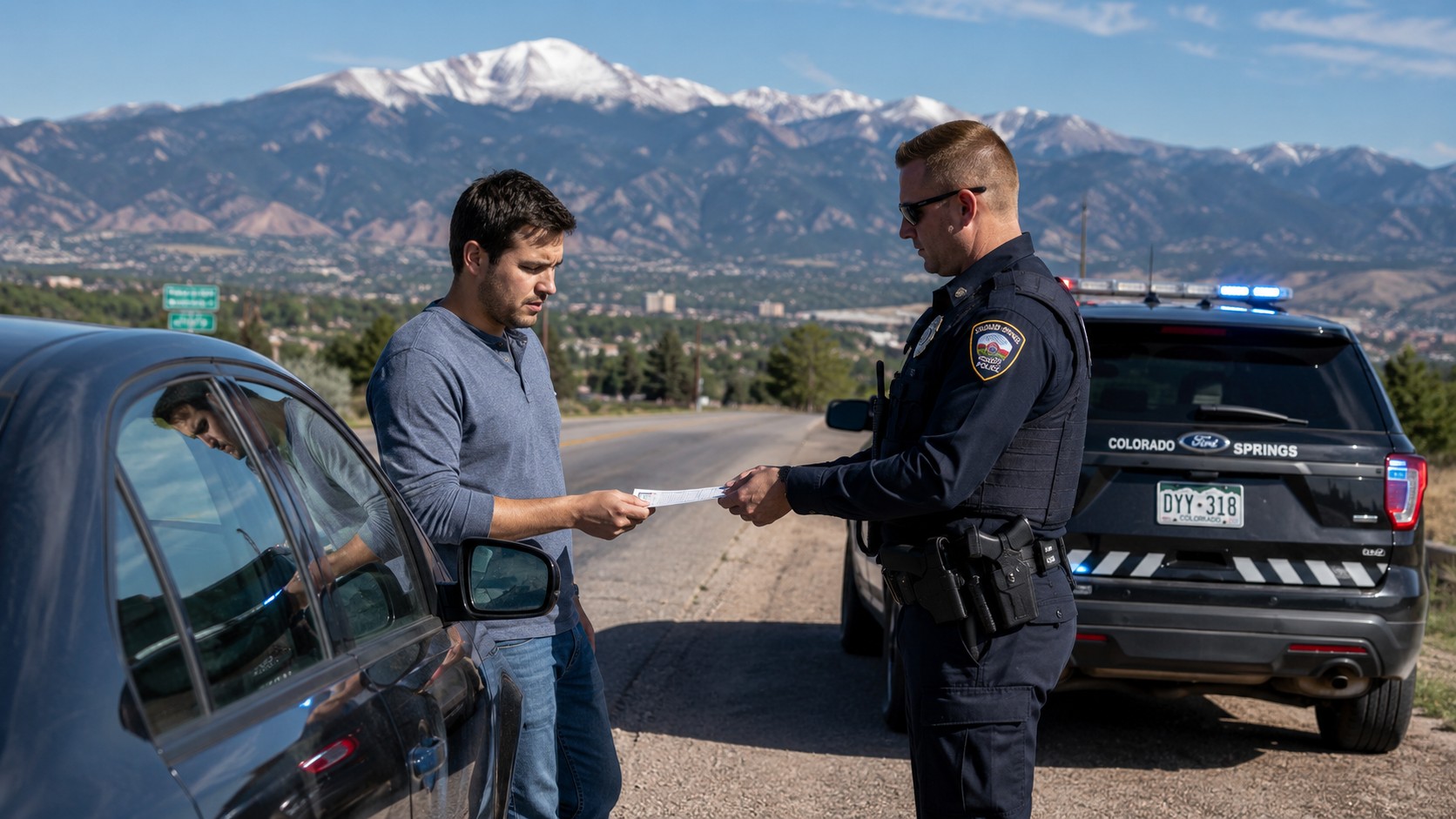
A single traffic ticket in Colorado Springs can add points to your driver's license, raise your insurance rates, and put your driving privileges at risk. Whether you are facing a speeding ticket, a careless or reckless driving charge, a driving under restraint case, or a DUI, the consequences build on each other quickly. Paying the fine without a fight means accepting every one of them.
Colorado Springs Criminal Defense, LLC represents drivers throughout El Paso, Teller, Pueblo and Fremont Counties. Attorney Aaron P. Gaddis has practiced criminal and traffic defense in Colorado since 2006, first as a state public defender and now in private practice in downtown Colorado Springs.
In This Article
- Why Drivers Choose Aaron P. Gaddis for Traffic Defense
- How Colorado Classifies Traffic Violations
- Colorado's Point System and License Suspension
- Our Colorado Springs Traffic Defense Services
- Where Traffic Cases Are Heard in Southern Colorado
- Should You Just Pay the Ticket?
- How Our Traffic Defense Process Works
- Reinstating Your License After a Suspension
- Areas We Serve
- Frequently Asked Questions
- Protect Your License
- Sources
Why Drivers Choose Aaron P. Gaddis for Traffic Defense
A traffic case is decided by details: how the officer measured your speed, what the citation actually says, which court has your case, and how many points are already on your record. A Colorado Springs native, Aaron P. Gaddis graduated from the University of Denver Sturm College of Law in 2006, passed the bar the same year, and spent his early career with the Colorado State Public Defender's Office in Silverthorne and Salida, where he practiced in the prison jurisdiction of Cañon City for more than four years. That background is why our law firm handles traffic matters the same way it handles felonies: with the evidence, not assumptions.
- Two decades in Colorado courtrooms. Since 2006 Aaron has handled thousands of court appearances across the state, including the Colorado Springs Municipal Court, El Paso County Court and the combined courts in Teller, Pueblo and Fremont Counties.
- Your constitutional rights come first. The stop, the officer's observations, the equipment and the paperwork all get scrutinized. If your rights were violated, we raise it.
- Realistic goals, honest advice. Every case is different. We will tell you what dismissal, a point reduction or a plea to a lesser charge realistically looks like for your citation, and then pursue it.
- Direct access to your attorney. Aaron is reachable around the clock, and you will always know where your case stands and what comes next.
- Downtown location. Our office at 10 Boulder Crescent Street, Suite 301, is a short walk from the Colorado Springs Municipal Court and the El Paso County Judicial Building.
How Colorado Classifies Traffic Violations
Not every ticket is the same kind of case. Colorado law divides traffic violations into civil infractions and criminal misdemeanor traffic offenses, and the difference decides whether jail is even possible.
Traffic infractions are civil matters under C.R.S. 42-4-1701. They carry fines, surcharges and points, but no jail. Most speeding tickets, failure to yield, improper lane changes and running a stop sign fall here.
Misdemeanor traffic offenses are crimes. A class 2 misdemeanor traffic offense carries 10 to 90 days in jail, a fine of $150 to $300, or both. A class 1 misdemeanor traffic offense carries 10 days to 12 months in jail, a fine of $300 to $1,000, or both. Courts may also order restitution and community service.
Speed alone can move a ticket from one category to the other. Under C.R.S. 42-4-1101(12), driving 1 to 24 mph over the limit is a class A traffic infraction. Driving 25 mph or more over the limit is a class 2 misdemeanor traffic offense, and the same conduct in a maintenance, repair or construction zone is a class 1 misdemeanor traffic offense.
Colorado's Point System and License Suspension
The Colorado Department of Revenue tracks points under C.R.S. 42-2-127. Points are counted by the date of the violation, but they are not assessed until you are convicted, and paying a ticket counts as a conviction. That is why the decision to fight a citation matters before you pay it.
Point totals that trigger a suspension hearing:
- Adults 21 and older: 12 points in any 12 consecutive months, or 18 points in any 24 consecutive months
- Minor drivers 18 to 20: 9 points in 12 months, 12 points in 24 months, or 14 total points for violations after turning 18
- Drivers under 18: 6 or more points in 12 months, or 7 or more total points before turning 18
- Chauffeurs whose principal job duty is driving: 16 points in one year, 24 in two years or 28 in four years, but only if every point was earned on the job. DUI, DWAI, UDD and leaving the scene are counted as if they happened off duty
Point values for common violations:
- Speeding 1 to 4 mph over: 0 points
- Speeding 5 to 9 mph over: 1 point
- Speeding 10 to 19 mph over: 4 points
- Speeding 20 to 39 mph over: 6 points
- Speeding 40 or more mph over: 12 points, which by itself meets the adult suspension threshold
- Failure to yield right of way: 3 points
- Careless driving, following too closely, running a sign or signal, improper passing, no proof of insurance: 4 points each
- Failure to stop for a school bus or school signals: 6 points
- Reckless driving: 8 points
- DWAI: 8 points
- DUI, leaving the scene of an accident, eluding a police officer, engaging in a speed contest: 12 points each
When your record reaches a threshold, the DMV schedules a hearing. A point suspension can run up to one year, and the hearing officer may authorize a probationary license for work, school or medical needs. Points reported by municipal courts, out-of-state courts and military courts on Colorado installations all count.
Colorado also has a separate habitual traffic offender law. Three major convictions within seven years, such as DUI, DWAI, reckless driving or driving under restraint, bring a five-year revocation. Driving during that revocation is its own crime under C.R.S. 42-2-206, with a mandatory minimum of 30 days in jail, a $3,000 fine, or both.
Our Colorado Springs Traffic Defense Services
Our practice covers the full range of traffic matters, from a first speeding ticket to criminal traffic charges that carry jail time. Below are the cases we handle most often.
Speeding and Moving Violations
Most of the drivers who call us are dealing with speeding, failure to yield, unsafe lane changes and similar moving violations. Even at the infraction level, a 4-point or 6-point conviction can push a working driver toward a suspension hearing within a year. We examine the radar or lidar calibration and certification records, the officer's training, the visual estimate that preceded the reading, and whether the stop itself was lawful. When the facts support it, we negotiate a reduction to a lower-point offense or a non-moving violation.
Careless and Reckless Driving
These are criminal charges, not simple tickets. Careless driving is a class 2 misdemeanor traffic offense carrying 4 points, and it becomes a class 1 misdemeanor traffic offense when it causes bodily injury or death. Reckless driving, which requires a wanton or willful disregard for safety, is a class 2 misdemeanor traffic offense carrying 8 points. A first conviction carries 10 to 90 days in jail and a fine of $150 to $300; a second carries 10 days to six months and a fine of $50 to $1,000.
Careless driving is often the charge that follows an accident, and prosecutors sometimes file reckless driving on facts that only support carelessness. We look at road conditions, signage, witness statements, vehicle data and the crash report to hold the prosecution to the actual standard in the statute.
License Suspension Defense and DMV Hearings
Point suspensions, habitual traffic offender revocations and express consent revocations after a DUI arrest are all decided in administrative hearings, not in criminal court. We fight to save your license at both stages: contesting the underlying conviction where possible, and representing you before the DMV hearing officer to argue for a shorter restraint or a probationary license.
DUI and DWAI Traffic Defense
A DUI conviction adds 12 points to your record; a DWAI adds 8. Under C.R.S. 42-4-1307, a first DUI carries five days to one year in jail, a fine of $600 to $1,000 and 48 to 96 hours of public service. A first DWAI carries two to 180 days, a fine of $200 to $500 and 24 to 48 hours of public service. A DUI arrest also triggers a separate DMV revocation case with a very short deadline to request a hearing. Impaired driving that causes serious bodily injury is charged as vehicular assault, a class 4 felony.
Our DUI defense practice challenges the legality of the stop, the roadside sobriety testing, and the collection and handling of breath and blood evidence under C.R.S. 42-4-1301.
Driving Under Restraint and Habitual Traffic Offender Cases
Driving while your license is suspended, revoked or denied is a criminal charge, and it is one of the offenses that counts toward habitual traffic offender status. Many of these cases turn on whether the driver actually knew of the restraint and whether the DMV's notice was valid. If you have been charged with driving under restraint or driving after revocation prohibited, the stakes include mandatory jail, so call before your first court date.
CDL and Professional Driver Defense
For commercial drivers, a citation that a private motorist could absorb can end a career. Federal CDL rules add disqualification periods for repeat serious violations on top of Colorado points, and Colorado's points-waiver program for driving improvement courses is not available for violations committed while operating under a CDL under C.R.S. 42-2-127.1. We defend commercial drivers with those elevated stakes in mind, focusing on outcomes that keep the CDL intact.
Other Common Charges: No Insurance, Distracted Driving and Hit and Run
Several everyday citations carry more weight than drivers expect. Failure to maintain or show proof of insurance is a 4-point violation, and the DMV can require SR-22 coverage after an insurance-related restraint. A first texting-while-driving violation under C.R.S. 42-4-239 adds 2 points, with the point value rising for repeat violations within 24 months. Leaving the scene of an accident is a 12-point offense, enough on its own to reach the adult suspension threshold, and when someone is injured it becomes a serious criminal charge in its own right.
Each of these cases has its own defenses. Insurance cases are frequently dismissed or reduced once valid coverage on the date of the stop is documented. Distracted driving cases often turn on what the officer actually observed. Accident cases depend on whether the driver knew a collision occurred and whether the required information was exchanged. We review the facts before anyone assumes the ticket is unwinnable.
Out-of-State and Military Drivers
If you were ticketed while passing through Colorado Springs, or you are stationed at Fort Carson, Peterson Space Force Base or Schriever Space Force Base and have since moved, you may not need to return for court. The Colorado Springs Municipal Court offers a remote disposition process for defendants who live outside El Paso County, and in many misdemeanor and infraction cases the court will allow your attorney to appear on your behalf. We handle the paperwork and the appearances so your case is resolved without disrupting your life.
Where Traffic Cases Are Heard in Southern Colorado
Which court has your case depends on who wrote the ticket and where. A Colorado Springs Police Department citation for a city ordinance violation goes to the Colorado Springs Municipal Court at 224 East Kiowa Street. A citation from the Colorado State Patrol or the El Paso County Sheriff's Office under state law goes to El Paso County Court at the El Paso County Judicial Building, 270 South Tejon Street, part of the Fourth Judicial District.
Fountain, Manitou Springs and Monument have their own municipal courts. Teller County cases are heard in the Teller County Combined Court in Cripple Creek. We also appear in the Pueblo County Combined Courts in the Tenth Judicial District and the Fremont County Combined Courts in Cañon City in the Eleventh Judicial District. Each court has its own procedures, prosecutors and typical offers, and knowing those differences is part of the job.
Should You Just Pay the Ticket?
Paying the amount printed on your summons is a guilty plea. The Colorado Springs Municipal Court says so directly on its traffic court page: payment establishes a guilty plea and the points are reported to the DMV. You give up the right to see the evidence, question the officer or negotiate.
There is one thing you should know before deciding. Under C.R.S. 42-2-127(5.5), paying a penalty assessment on time reduces the points for a 3-point or higher violation by 2 points, and a 2-point violation by 1 point. Colorado Springs applies this as an automatic point reduction for payable tickets of 4 points or less. For a driver with a clean record and a minor ticket, that may be a reasonable outcome.
It is a poor outcome for many others. If you already have points on your record, hold a CDL, are under 21, were ticketed for 25 mph or more over the limit, or face careless driving or another criminal traffic charge, a reduced-point conviction still moves you closer to suspension and still creates a record that insurers and employers can see. A free consultation costs nothing and tells you which situation you are in.
How Our Traffic Defense Process Works
Step 1: Free Consultation and Case Review
Contact us and send a photo of your summons. We identify the court, the exact charge and its classification, the points at stake, and any deadline you are already facing, including the ten-day lead time for a remote disposition request and any DMV hearing deadline. You leave the call knowing exactly what you are up against.
Step 2: Investigation and Strategy
We request discovery from the prosecution: the officer's notes, dash and body camera footage, radar or lidar certification and calibration records, and any crash report. Was the speed measurement reliable? Did the officer have a lawful basis for the stop? Does the citation charge the right offense? From there we prepare for both negotiation and trial, because prosecutors offer their best deals to attorneys who are ready to try the case.
Step 3: Court Representation and Resolution
We appear in court on your behalf, present your defense, and pursue the result that protects you most: dismissal, a reduction to a lower-point or non-moving offense, a deferred sentence, or minimized penalties. If you have an outstanding warrant from a missed court date, we address that at the same time so the old problem does not follow the new one.
Reinstating Your License After a Suspension
Colorado driving privileges are never restored automatically. Once the suspension period ends, you must apply to the DMV and satisfy every condition of the restraint. According to the Colorado DMV, that generally means:
- Submitting an Application for Reinstatement, form DR 2870, online through myDMV or by mail
- Paying the $95 reinstatement fee, plus a $25 restoration fee if the restraint stemmed from a DUI
- Providing proof of insurance, including SR-22 coverage where required
- Paying any underlying ticket and obtaining a compliance document from the court if the suspension was for a failure to pay or appear
- Completing any required vision, written or driving tests, and any ordered education or treatment
Driving before reinstatement is complete is driving under restraint, a new criminal charge. We guide clients through the reinstatement checklist so the license comes back on time and stays back.
Areas We Serve
We defend drivers throughout El Paso, Teller, Pueblo and Fremont Counties, including:
- Downtown Colorado Springs, Old Colorado City and the Broadmoor area
- Fountain, Security-Widefield and Fort Carson
- Monument, Palmer Lake and the Tri-Lakes area
- Manitou Springs
- Falcon, Peyton and Black Forest
- Cimarron Hills, Stratmoor and Stetson Hills
- Woodland Park and Cripple Creek in Teller County
- Pueblo and Pueblo West in Pueblo County
- Cañon City and Florence in Fremont County
Frequently Asked Questions
Should I Just Pay My Colorado Springs Traffic Ticket?
Paying is a guilty plea that puts points on your record and a conviction in your history. Colorado law does reduce points for on-time payment of minor penalty assessments, so for a first low-point ticket that may be acceptable. If you already have points, drive commercially, are under 21, or face a criminal traffic charge, talk to a lawyer before paying. The consultation is free.
How Much Does a Traffic Lawyer Cost in Colorado Springs?
We offer flat-fee pricing for most misdemeanor traffic cases, so you know the full cost before you commit. The fee depends on the charge, the court and whether a DMV hearing is involved. We quote it at your free consultation, and you can weigh it against the fines, surcharges, points and insurance increases you would face without a defense.
Can You Handle My Case if I Live Out of State?
Yes. We regularly represent out-of-state drivers ticketed in Colorado Springs. The Municipal Court's remote disposition process is available to defendants who live outside El Paso County, provided the request is submitted at least ten days before the court date, and many misdemeanor and infraction cases can be resolved with the attorney appearing for you. We will tell you at the consultation whether your case qualifies.
What Happens if I Miss My Court Date?
For a criminal traffic charge, a missed appearance usually results in a bench warrant. For an unpaid or unanswered ticket, the court reports a failure to pay to the DMV, which can suspend your license until you pay the ticket and provide the DMV with a compliance document from the court. If you have already missed a date, contact us right away; resolving the warrant quickly limits the damage.
How Long Do Points Stay on My Colorado Record?
The DMV looks at points within rolling 12-month and 24-month windows when deciding whether to suspend a license, so a conviction affects your suspension exposure for at least two years. The conviction itself remains part of your driving history, which is what insurers review.
What Is the Difference Between Careless and Reckless Driving?
Careless driving means driving without due regard for the road, traffic and conditions; it is a negligence standard. Reckless driving requires a wanton or willful disregard for the safety of people or property, which is a much higher bar. Both are class 2 misdemeanor traffic offenses, but reckless driving carries 8 points to careless driving's 4, and it counts as a strike toward habitual traffic offender status. Reducing a reckless charge to careless is one of the most common outcomes we pursue.
Can I Negotiate With the Prosecutor Myself?
You can. At the Colorado Springs Municipal Court, city prosecutors are available to talk with defendants about their citations on the court date. The difficulty is knowing what to ask for and what the evidence supports. A prosecutor's opening offer is rarely the floor, and a self-represented driver usually does not know the calibration, procedural and charging issues that change the offer. A free consultation before your court date lets you make that decision with full information.
Will a Traffic Ticket Raise My Insurance?
It can. Insurers review driving records at renewal, and moving violations and points are among the factors that increase premiums. How much, and for how long, depends on your carrier and your history. Avoiding the conviction, or reducing it to a non-moving violation, is the most reliable way to keep a ticket off your insurance record.
Protect Your License
Traffic cases have deadlines, and the options narrow as your court date approaches. Whether you are facing a single speeding ticket, a careless or reckless driving charge, a DUI, or a suspension hearing, the sooner we see your summons the more we can do with it.
Schedule your free consultation today. We will review your citation, explain the points and penalties you are facing, and lay out your options plainly.
Colorado Springs Criminal Defense, LLC
10 Boulder Crescent Street, Ste. 301, Colorado Springs, CO 80903
(719) 578-3344

Sources
- C.R.S. 42-2-127, Authority to suspend license, point system schedule
- C.R.S. 42-2-127.1, Driving improvement course, points waiver
- C.R.S. 42-2-202, Habitual offenders
- C.R.S. 42-2-206, Driving after revocation prohibited
- C.R.S. 42-4-1101, Speed limits
- C.R.S. 42-4-1301, Driving under the influence, driving while ability impaired
- C.R.S. 42-4-1307, Penalties for traffic offenses involving alcohol and drugs
- C.R.S. 42-4-1401, Reckless driving
- C.R.S. 42-4-1402, Careless driving
- C.R.S. 42-4-1701, Traffic offenses and infractions classified, penalties
- C.R.S. 18-3-205, Vehicular assault
- Colorado DMV, Suspension and Reinstatement FAQs
- Colorado DMV, Process to Reinstate Driving Privilege
- City of Colorado Springs, Municipal Court
- City of Colorado Springs, Traffic Court
- City of Colorado Springs, Remote Disposition Process
