We Fight To Save Your License
If you've been arrested for DUI in Colorado Springs, your driver's license is already on a countdown. You have seven days from the day you receive your Notice of Revocation to request a DMV hearing - miss that window, and your license is revoked without any chance to fight back. If you need a Colorado Springs DMV hearing lawyer, Aaron Gaddis and Colorado Springs Criminal Defense, LLC represent local drivers in these time-sensitive hearings to challenge DUI-related revocations and protect their driving privileges.
A DUI arrest can trigger both criminal charges and separate DMV administrative action, including express consent revocation, point suspension, and post-conviction revocation hearings, and the DMV side moves faster with its own deadlines, procedures, and defense strategies. Aaron Gaddis and Colorado Springs Criminal Defense, LLC have been defending Colorado Springs drivers since 2006. If you're facing a DMV hearing, call (719) 578-3344 for a free consultation now - early legal help can preserve your right to a hearing and coordinate your DMV defense with your criminal case before the seven-day deadline runs out.
Why Colorado Springs Drivers Trust Aaron Gaddis
Defending Colorado Springs clients since 2006 - nearly two decades of criminal defense and DMV hearing experience
Free consultation for every DMV hearing and DUI case - no cost to find out where you stand
Centrally located at 10 Boulder Crescent Street, Ste. 301, Colorado Springs, CO 80903
Real results in Colorado DMV hearings - fighting to preserve driving privileges for clients across El Paso County
Why Colorado Springs Chooses Aaron Gaddis for DMV Hearings
When your Colorado driving privilege is at stake, you need a DMV attorney who knows the local landscape - not someone learning on the fly. Aaron Gaddis has spent years understanding how El Paso County law enforcement operates, how Department of Revenue hearing officers evaluate evidence, and what defenses actually work in Colorado administrative hearings.
Local experience matters - familiarity with Colorado Springs Police and El Paso County Sheriff's Office DUI procedures, local testing practices, and Division of Motor Vehicles procedures means stronger challenges to the state's case
Aggressive advocacy - Aaron doesn't just show up; he represents clients at DMV hearings, requires or subpoenas the arresting officer, challenges the express consent affidavit and the legality of the stop and arrest, and fights calibration and chain-of-custody issues
Personalized attention - every DMV hearing case gets individual strategy, not a cookie-cutter approach
Full-spectrum defense - as a criminal defense attorney handling DUI cases, Aaron coordinates your DMV hearing with your criminal case for the strongest possible outcome on both fronts
Our Colorado Springs DMV Hearing Services
Colorado drivers face several types of administrative hearings that can result in losing their license. Here's what we handle:
Express Consent Hearings
Under Colorado's Express Consent Law, C.R.S. 42-4-1301.1, anyone driving in Colorado is deemed to have consented to a chemical test of breath or blood when a police officer has probable cause to believe the driver committed DUI, DUI per se, or DWAI. The per se BAC limit is 0.08 (measured at the time of driving or within two hours after driving); for commercial vehicle drivers it is 0.04, and for drivers under 21 it is 0.02.
If you refused the test, or took a breath test that came back at 0.08 or higher, the arresting officer serves an Express Consent Affidavit and Notice of Revocation on the spot, takes your license, and issues a temporary permit that is valid for seven days. If you took a blood test, the DMV mails you the Notice of Revocation once the lab results come back, and the notice is deemed received three days after mailing. Either way, the revocation takes effect seven days after you receive (or are deemed to receive) the notice unless you request a hearing in writing within that window (C.R.S. 42-2-126(6)-(7)).
The administrative penalties under C.R.S. 42-2-126(3) and the Colorado DMV are:
First BAC 0.08 or higher (excess BAC): nine-month revocation. Colorado residents 21 and older can reinstate early with an ignition interlock restricted license after serving one month. If your BAC was 0.15 or higher, you are designated a Persistent Drunk Driver, must complete Level II alcohol education and treatment, and must hold an interlock restricted license for at least two years after reinstatement.
First refusal: one-year revocation, automatic Persistent Drunk Driver designation, Level II education and treatment, and an interlock restricted license for at least two years upon reinstatement. Early reinstatement with interlock is currently available after two months (that two-month wait is eliminated by HB26-1242 effective June 1, 2027).
Repeat violations: one year for a second excess BAC violation and two years for a third; two years for a second refusal and three years for a third or subsequent refusal.
Beginning June 1, 2027, HB26-1242 also requires most first-time DUI offenders to hold an interlock restricted license for the revocation period rather than simply waiting out the revocation without a device.
These consequences are imposed by the DMV independent of your criminal case - a dismissal or acquittal in court does not undo an express consent revocation (C.R.S. 42-2-126(6)(a)). That is why acting quickly at this stage matters. At the hearing you can challenge whether the officer had probable cause, whether the stop and arrest were lawful (C.R.S. 42-2-126(8)(h)), whether the express consent advisement was properly given, whether the test was completed within two hours of driving, and whether the testing equipment and procedures were valid.
Point Suspension Hearings
If you've accumulated too many points on your driving record, the Colorado Department of Revenue will move to suspend your license under C.R.S. 42-2-127. Per the Department of Revenue Hearings Division, the thresholds for drivers 21 and over are 12 or more points in any 12 consecutive months or 18 or more points in any 24 consecutive months. Drivers 18 to 20 are suspended at 9 points in 12 months, 12 points in 24 months, or 14 points total between ages 18 and 21; drivers under 18 at 6 points in 12 months or 7 points before turning 18. A point suspension can run up to one year.
The DMV mails a notice of hearing for point suspensions, and the hearing officer sets the length of the suspension. At the hearing, we can argue for a shorter suspension and for a probationary license (sometimes called a "red license") that lets you keep driving for specific purposes such as work, school, and medical care under defined conditions. Whether the issue is a single serious ticket or an accumulation of violations, Aaron works to present the evidence that supports keeping you on the road.
License Revocation Hearings
Suspension is a temporary withdrawal of your driving privilege that ends when the suspension period runs and you pay the reinstatement fee and meet any conditions. Revocation is a termination of the privilege - when the revocation period ends, your license is not simply reactivated; you must apply for reinstatement and satisfy the DMV's requirements, which can include an SR-22 insurance filing, a reinstatement fee, alcohol education and treatment, and an ignition interlock device. Revocation is not permanent, but the reinstatement path is more demanding and the interlock and Persistent Drunk Driver consequences can follow you for years.
Revocation typically follows an express consent action (refusal or excess BAC), a DUI, DUI per se, or DWAI conviction reported by the court under C.R.S. 42-2-125, or other serious alcohol and drug offenses. Having an attorney involved from the start can make a real difference in whether the revocation is imposed at all, in coordinating the administrative and criminal timelines, and in pursuing early reinstatement options.
How the DMV Hearing Process Works
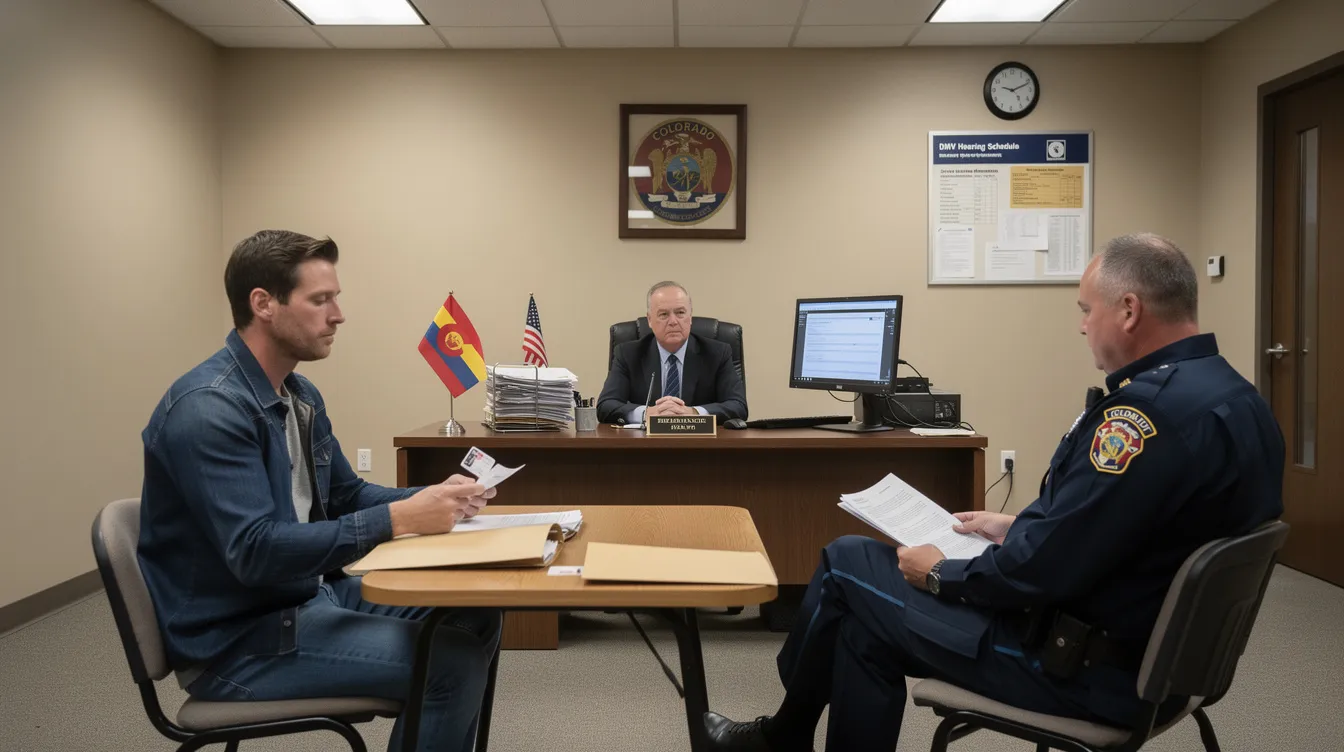
A Colorado DMV administrative hearing is separate from criminal court proceedings. The standard of proof at an express consent hearing is a preponderance of the evidence - a lower bar than "beyond a reasonable doubt" in your DUI trial. The hearing officer may consider the officer's affidavit and reports even if the officer does not appear, and hearsay can be considered if it is reliable, so the rules of evidence are more relaxed than in criminal court. Here's how the process unfolds:
Step 1: Request a Hearing Within 7 Days
You must request a hearing in writing within seven days after you receive the Notice of Revocation (C.R.S. 42-2-126(7)(b)). This is the most critical deadline. If the DMV does not receive your request within that window, your right to a hearing is waived and the revocation becomes final based on the officer's paperwork alone.
A late request is only granted on narrow statutory grounds: you must submit a verified statement, and the DMV reopens the matter only if you were unable to make a timely request because you lacked actual notice of the revocation or because of physical incapacity such as hospitalization or incarceration (C.R.S. 42-2-126(7)(c)). Colorado courts have held those are the exclusive grounds, and even then the revocation is not stayed while you wait for the late hearing. This is why you need to act quickly.
Aaron files your hearing request immediately. When the request is made on time and your license has been surrendered, the DMV stays the revocation and issues a temporary permit valid until the hearing date, which can be extended until the hearing officer issues a final order (C.R.S. 42-2-126(7)(d)). Any delay requested by you or your attorney does not stay the revocation during the period of delay, so scheduling decisions matter.
Step 2: Hearing Preparation and Representation
Once the request is received, C.R.S. 42-2-126(8)(a) requires the hearing to be held as quickly as practicable and not more than 60 days after the DMV receives the request (with limited exceptions for officer or hearing officer unavailability). At the time you request the hearing you can also require the arresting officer to appear, or subpoena the officer at least five days before the hearing. Cross-examining the officer often exposes procedural errors the DMV's case relies on.
Aaron gathers the full express consent packet, blood or breath test results, calibration and certification records for the testing equipment, and officer statements, and prepares challenges to test validity, timing, and procedural compliance. Prior alcohol-related revocations change both the stakes and the strategy, and Aaron accounts for that from the outset.
The Department of Revenue Hearings Division currently conducts driver license hearings by Zoom, with an option to appear by phone. Whether the officer appears in person, remotely, or not at all can work to your advantage or disadvantage depending on the circumstances, and Aaron determines which approach gives you the strongest position.
Step 3: Hearing Outcome and Next Steps
In an express consent hearing, the hearing officer issues a written decision that either sustains the revocation or dismisses it. If the revocation is dismissed, your driving privilege remains valid and your license is reissued at no charge. If it is sustained, the revocation goes into effect for the statutory period, and any early reinstatement is through the interlock restricted license process rather than a probationary license (C.R.S. 42-2-126(4)(b) and 42-2-132.5). In point suspension hearings, by contrast, the hearing officer can shorten the suspension and may authorize a probationary license for limited purposes; violating those restrictions can cost you the probationary license.
If the hearing officer sustains the revocation, you can seek judicial review. Under C.R.S. 42-2-126(9), you must file a petition in the district court in your county of residence within 35 days after the final determination. The court reviews the hearing record without new testimony and can reverse if the DMV exceeded its authority, misinterpreted the law, acted arbitrarily and capriciously, or made a determination unsupported by the record. Filing does not automatically stay the revocation. Colorado appellate decisions - including Wilson v. Hill (Colo. App. 1989) and more recently Emmons v. Department of Revenue (Colo. App. 2020) - hold that the 60-day hearing deadline is jurisdictional, and the DMV's failure to hold the hearing in time can require dismissal of the revocation action.
DMV Hearing Results
Aaron Gaddis has successfully preserved driving privileges for Colorado Springs clients facing express consent revocations, point suspensions, and refusal cases. Results include hearings where revocations were dismissed due to defects in the officer's advisement or paperwork, point hearings where probationary licenses were obtained to protect employment, and cases where procedural defects in the express consent affidavit led to favorable outcomes.
Choosing a DMV hearing lawyer requires evaluating their familiarity with express consent law and the Hearings Division's procedures. Local experience with El Paso County law enforcement can affect DMV hearing outcomes - and Aaron's two decades in Colorado Springs courtrooms and administrative hearings reflect that advantage. Express consent hearings take priority on the Department of Revenue's docket precisely because of the 60-day statutory deadline, and Aaron handles them regularly for Colorado Springs drivers.
Past results do not guarantee or predict a similar outcome in any future case. Every case depends on its own facts.
What Our Colorado Springs Clients Say
Client reviews consistently highlight Aaron's commitment to outcomes. As one FindLaw reviewer noted: he is "always professional … fought for the outcome I wanted … did what he said he would do."
Clients facing a drunk driving arrest and the prospect of losing their license praise the personalized attention and clear communication throughout the DMV hearing process. Many emphasize that Aaron's familiarity with DUI charges and the administrative side made a tremendous difference in their case outcomes.
Areas We Serve
Aaron Gaddis represents clients throughout the Colorado Springs metropolitan area and beyond:
Colorado Springs neighborhoods including Downtown, Old Colorado City, Briargate, Northgate, and the Powers Corridor
El Paso County communities throughout the region
Fountain, Security-Widefield, and Cimarron Hills
Monument, Palmer Lake, and northern El Paso County
Teller County including Woodland Park and Cripple Creek
Pueblo County including the City of Pueblo
Fremont County including Canon City and Florence
Douglas County and surrounding areas
Military installations including Fort Carson, Peterson Space Force Base, Schriever Space Force Base, and the U.S. Air Force Academy
Commercial driver license holders across the region - where the per se limit is 0.04 in a commercial vehicle and a DUI or refusal carries a federal disqualification of the commercial driving privilege
Frequently Asked Questions
How Much Does a DMV Hearing Lawyer Cost in Colorado Springs?
Aaron offers a free consultation for every DMV hearing case. Many Colorado Springs attorneys handle DUI and DMV defense, and flat-fee arrangements are common. For first-offense DUI cases including the DMV hearing, fees in the Colorado Springs market typically range from $2,500 to $7,500 depending on complexity. Compare that to the cost of losing your license: missed work, alternative transportation, higher insurance premiums, SR-22 filings, interlock costs, and potential job loss - especially for anyone holding a commercial driver license. Experience and results matter more than price alone.
What Happens If I Miss the 7-Day Deadline?
If the DMV does not receive your written hearing request within seven days after you receive the Notice of Revocation, your right to a hearing is waived and the revocation becomes final under C.R.S. 42-2-126(7)(b). A late request will only be granted if you file a verified statement showing you lacked actual notice or were physically unable to request the hearing because of hospitalization, incarceration, or similar incapacity - and Colorado courts treat those as the exclusive grounds, so a busy schedule or a missed letter is not enough. Even if the late hearing is granted, the DMV does not stay the revocation while you wait. This is why you must act immediately after any DUI arrest.
Can I Win My DMV Hearing Without a Lawyer?
Technically, yes. Practically, the odds drop significantly. DMV hearings involve technical evidence challenges - breath test certification and calibration records, blood test chain of custody, whether the officer properly gave the express consent advisement, whether the test was completed within two hours of driving, and whether the notice was properly served. You need to know what to cross-examine, when to require or subpoena the officer, and how to present evidence under administrative rules. The Hearings Division states plainly that hearing officers cannot give legal advice and that there is no right to appointed counsel in an administrative hearing. Without a lawyer, you may miss procedural defects that could have won your case.
How Long Do DMV Hearings Take in Colorado Springs?
Colorado statute requires the hearing to be held within 60 days after the DMV receives your request. Most express consent hearings last under an hour to a couple of hours depending on complexity - whether the officer testifies, whether expert testimony is offered, and how many issues are contested. Hearings are currently conducted by Zoom, with a phone option. The hearing officer issues a written decision, often at the conclusion of the hearing or shortly after. If you requested the hearing on time and surrendered your license, a temporary permit keeps you driving until the hearing date and, if extended, until the final order.

Protect Your Colorado Springs Driving Privileges Today
Every hour you wait brings you closer to losing your Colorado driver's license - and once that seven-day window closes, your options shrink dramatically. Whether you're facing an express consent revocation, a point suspension, or any other driver license matter, Aaron Gaddis has the experience and local knowledge to fight for the best possible outcome.
Colorado Springs Criminal Defense, LLC
Phone: (719) 578-3344 - call now for a free consultation
Address: 10 Boulder Crescent Street, Ste. 301, Colorado Springs, CO 80903
Don't let a missed deadline determine your future. Contact Aaron Gaddis today for a free consultation and start protecting your driving privileges now.
